
Finding Common Ground in Governance
By:Kadiatou Barry
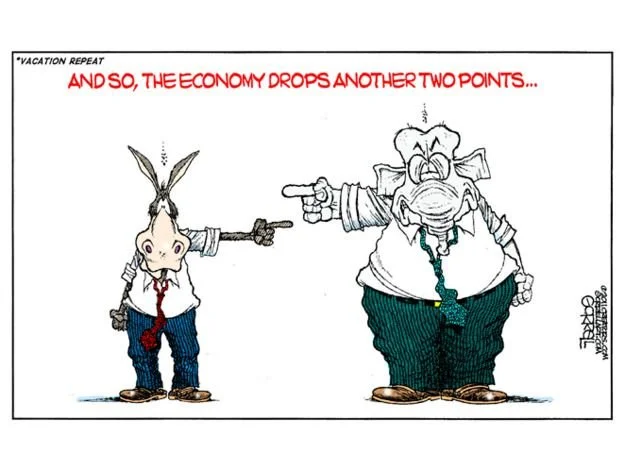
Political cartoon on the Republicans vs Democrats
Source: The Washington Post
Partisanship has long shaped the way government functions in the United States. The HistoryMakers archive offers insight into how leaders have navigated division, unity, and political strategy across decades of American life. Through their words, we see not only how parties clashed in public but also how moments of cooperation, community, and shared purpose emerged behind the scenes.
Ambassador and Congresswoman The Honorable Diane E. Watson recalled her work in the California legislature and the types of issues that could bring people together.
“Well, the health issues. Yes, you could get that support because and issues that the benefits of government for seniors, there's not a district in this country that doesn't have a senior and a child. So the educational issues, issues such as social security, Medicare, Medicaid, in the State of California, it's Medi-Cal. And I chaired the health and human services.”
For her, collaboration often began with shared human needs that transcended party lines.
Former Governor The Honorable L. Douglas Wilder, who made history as the nation’s first African American governor, also reflected on leadership within a divided political environment.
“Legislative Black Caucus with Democrats not in authority in the house, and not with the same degree of punch because as you pointed out, I was chairman of all kinds of committees and people had to, had to listen whether they liked it or not. If you're in the political process, if you're in a position of authority, you can demand some respect.”
Civic Leader Thomas W. Dortch Jr. shared a glimpse of bipartisanship away from the public eye.
“I used to see these individuals on the Florida House and Senate Democrats and Republicans down there fighting like cats and dogs and after each other. And then when they left the floor, when the cameras weren't on 'em, how close of friends they were when they'd be in the cloak room or leaving and talking about, well, are we gonna have dinner tonight, and how's your brother and sister, and did that thing work out for them? Call me if you need me. You learn that when you're on the stage and you're trying to get your point over, you deal on the stage.”
These reflections show that while public debate often appeared fierce, personal relationships sometimes offered a quiet bridge.
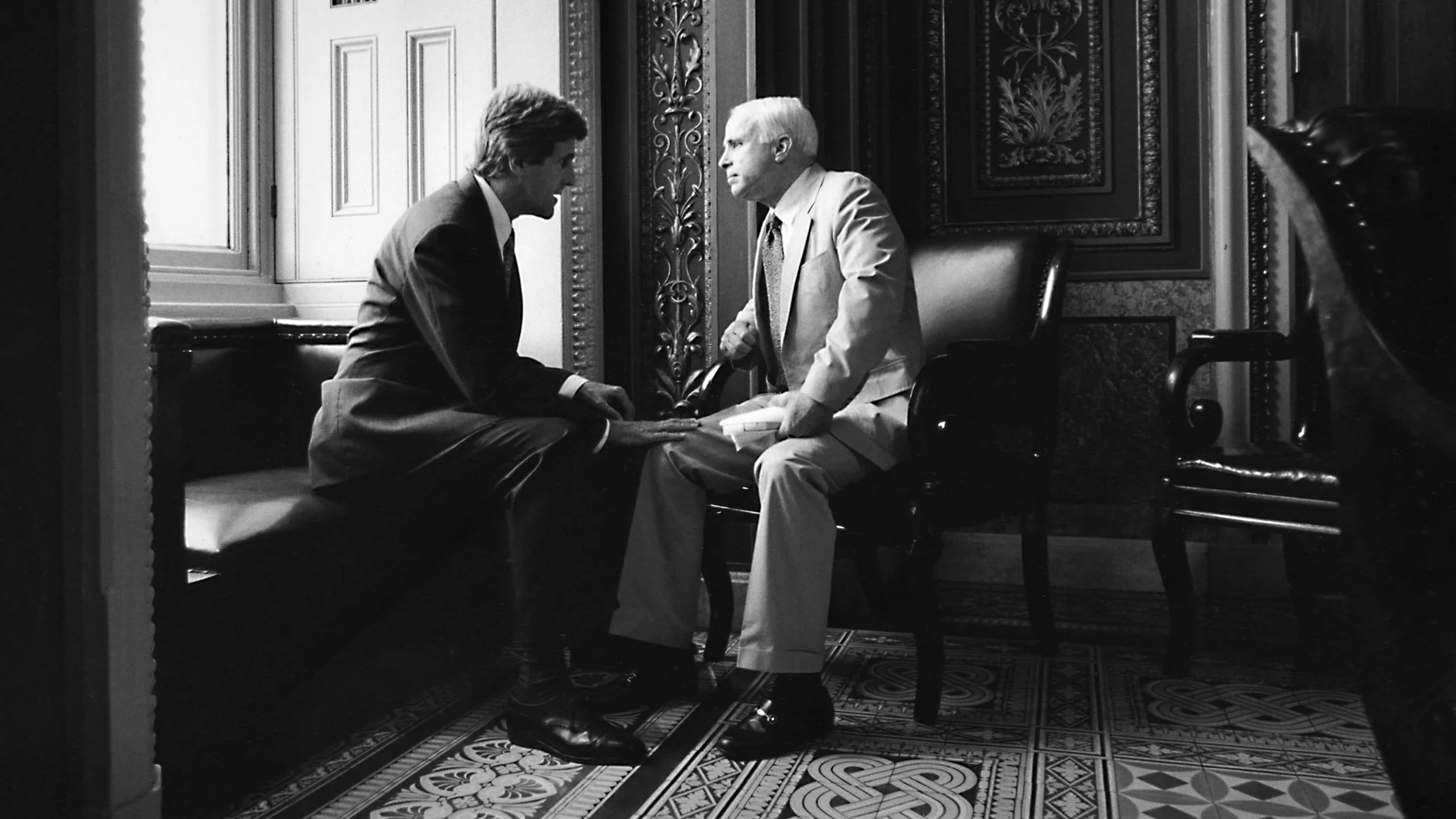
Senators John McCain of Arizona and John Kerry of Massachussets showing an example of bipartisan friendship
Source: Hewlett Foundation
Political differences were not confined to parties. Within social movements and identity groups, internal divides often emerged.
State Representative Doris Bunte, co-founder of the Massachusetts Caucus of Women Legislators, spoke about unity and tension among women in politics.
“There are things that divide women, and I can't think to tell you the truth of an issue that might divide the members of the black caucus. There may be an issue we don't agree on, but I can't think of an issue that might divide us. But with women, it's different and so it took a while.”
Civil Rights Lawyer and former Richmond mayor The Honorable Henry L. Marsh III urged unity within the Black community.
“We really need to come together as a race now more than ever before. The enemy has found a way to divide us and that's the strategy for halting black progress, divide and conquer, and if we don't find a way to unite and stay united, we're not going to progress.”
Former U.S. Secretary of Labor The Honorable Alexis Herman recalled how even within the African American community, political loyalties could create tension.
“And there was a clear divide in the African-American community between those who supported Senator Kennedy and those who supported President Carter, because obviously in the African-American community the Kennedy name, the legacy of John Kennedy, the legacy of Bobby Kennedy, his relationship to Dr. King.”
These voices highlight how division can take many forms, sometimes arising within the very communities fighting for equality and representation.
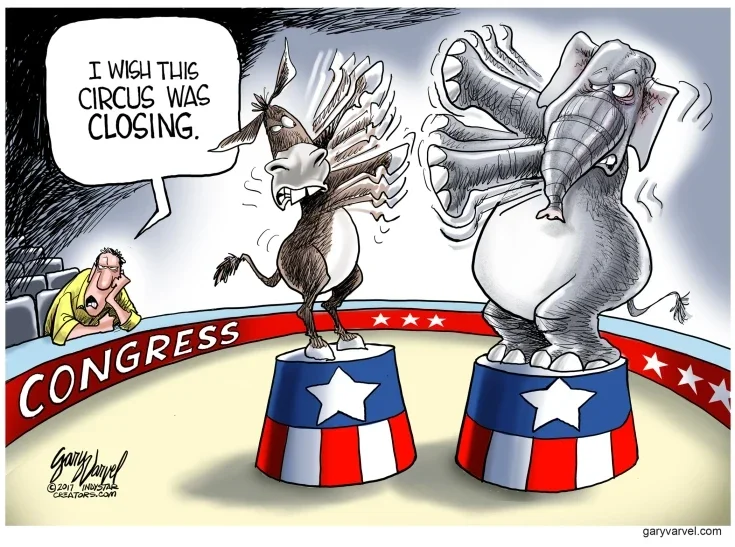
A cartoon showing bipartisan tension
Source: National Constitution center
Partisan division also shapes the structure of government itself, from redistricting to the confirmation of judges.
Lawyer Walter C. Carrington described political disagreement in Massachusetts.
“There was a disagreement between the legislature and the governor as to how the state should be redistricted afterwards and they couldn't come up with a redistricting plan because, one, you had the Democrats and the Republicans fighting. And so the decision was made that since there was no they couldn't redistrict, that all, everybody running for congress.”
Congresswoman The Honorable Eddie Bernice Johnson explained how redistricting could weaken minority representation.
“We lost really a majority of the Democrats, because they the way they did it was split up the minority votes into little squares, little triangles, and put them into majority white districts that where they were voting primarily Republican.”
The Honorable Audrey Collins described gridlock over judicial appointments and how partisanship could stall progress.
“There's been a judgeship bill before Congress virtually every year that is based on statistics. It just doesn't go anywhere because if you approve new judges, then that president gets to pick them. So the party that's not in power saying, ‘Well wait a minute, that means this president, not in my party, is gonna pick,’ you know, like say for the Central District, ‘five more judges? No.’ Then another party gets in power and it's the same thing. ‘Wait a minute, this party's gonna get to pick 'em?’ Gridlock.”
These accounts reveal how the mechanics of government often mirror the ideological divides that run through the country, with compromise giving way to stalemate.
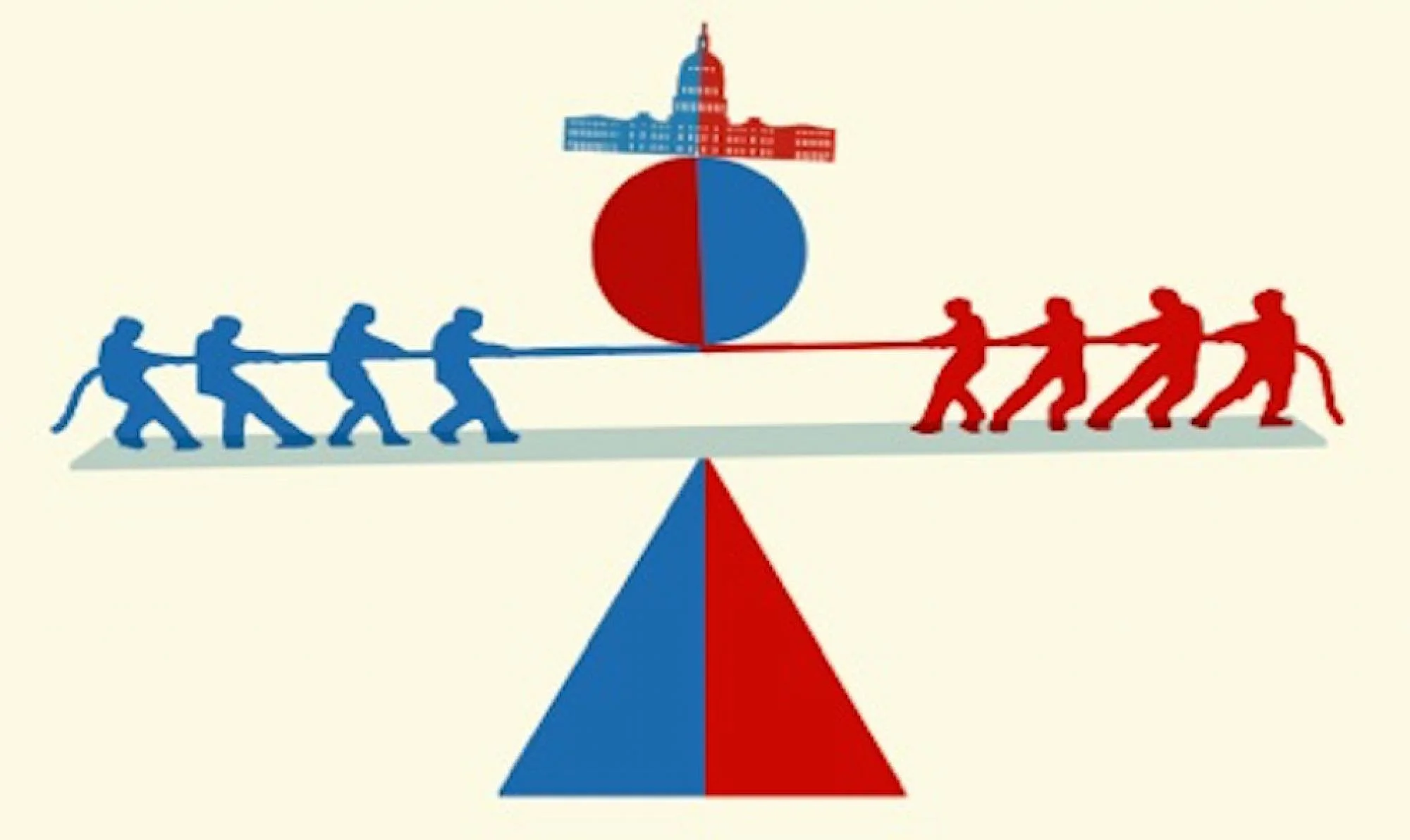
Depiction of a gridlocked Congress
Source: University of Chicago Harris School of Public Policy
The Honorable Joseph Segar remembered disputes in Congress over international alliances.
“We had in Congress conservatives who felt that we never should have supported the revolution. They were right, very happy with Ian Smith and Rhodesia and felt that it should remain that way.”
U.S. Congressman William Jefferson spoke about the evenly split electorate and the balance of power in Washington.
“There aren't any discrete districts that have advantages for any particular party or other. And the presidency, it's a divided issue over the presidency and has been for the last so many years. And the same in the Senate, where the country is almost fifty-fifty divided on these questions between the Republicans and Democrats. Which means that a slip by President Bush, a further slip on the economy, the issues of credibility on the war now. About whether he compromised the intelligence agencies? Whether they told us the truth or not? Or whether they failed to know what was going on.”
He also reflected on the political costs of division.
“We had the Brady Bill. And we had an automatic weapons bill. And the issue was whether the President was gonna put that those two that bill on a crime bill or whether he was gonna let it be a free standing gun bill and the crime bill without the guns attached to it. Chuck Schumer and a lot of folks from the area said, ‘Boy these are very nice issues. All the issues should be together. We should take the stand as Democrats against guns, guns and such and such and such.’”
These moments show how national debates over guns, war, and redistricting reflect the enduring struggle to balance conviction with cooperation.
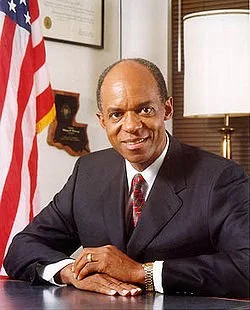
Congressman William J.Jefferson
Source: Congress.gov
Across these testimonies runs a shared concern for the health of democracy and the need to bridge divides both within and beyond political parties. Whether through collaboration across the aisle, unity within communities, or the ongoing effort to reform systems that perpetuate division, the voices in The HistoryMakers archive remind us that progress depends not only on power but also on understanding.
Search Terms: “Partisan Divide”= 7 stories
“Governement” + “Divide”= 106 stories
“Congress” + “Divide”= 55 stories
“Black Caucus” + “divide”= 14 stories
Government Divide: 365 stories
Citations:
Joseph Segars (The HistoryMakers A2004.124), interviewed by Racine Tucker Hamilton, August 11, 2004, The HistoryMakers Digital Archive. Session 1, tape 3, story 3, Joseph Segar describes disagreements over U.S. policy during the transition from Rhodesia to Zimbabwe
The Honorable Walter C. Carrington (The HistoryMakers A2007.069), interviewed by Larry Crowe, February 14, 2007, The HistoryMakers Digital Archive. Session 1, tape 5, story 5, The Honorable Walter C. Carrington recalls his political activities in Massachusetts
Thomas W. Dortch, Jr. (The HistoryMakers A2002.018), interviewed by Julieanna L. Richardson, March 12, 2002, The HistoryMakers Digital Archive. Session 1, tape 5, story 4, Thomas Dortch describes learning the political process while working with Senator Sam Nunn from 1978-1995
The Honorable Eddie Bernice Johnson (The HistoryMakers A2012.094), interviewed by Larry Crowe, June 18, 2012, The HistoryMakers Digital Archive. Session 2, tape 9, story 1, The Honorable Eddie Bernice Johnson recalls the Women's Health Equity Act
The Honorable Audrey Collins (The HistoryMakers A2013.344), interviewed by Larry Crowe, December 18, 2013, The HistoryMakers Digital Archive. Session 1, tape 5, story 7, The Honorable Audrey Collins talks about the need for new judicial positions
The Honorable William Jefferson (The HistoryMakers A2003.127), interviewed by Larry Crowe, June 11, 2003, The HistoryMakers Digital Archive. Session 2, tape 4, story 2, William Jefferson discusses how Democrats could take back control from Republicans
The Honorable William Jefferson (The HistoryMakers A2003.127), interviewed by Larry Crowe, June 11, 2003, The HistoryMakers Digital Archive. Session 2, tape 3, story 4, William Jefferson analyzes why Democrats lost their House majority in 1994